|
"What is new beyond the program is the scale of
the production. We have more partners than ever (over
50 organizations supporting the event), more
speakers (35+ stage appearances across both days),
and registrations are running ahead of last year. We
are more or less sold out since a few weeks
back, only releasing cancelled tickets."
With
those comments, the interview was just getting
started. Here is the rest of the conversation:
DNJournal:
This is shaping up to be a landmark year for the
domain industry. We are in a booming aftermarket
and of course a long-awaited round of new gTLD
applications has now opened. What are some of
the sessions and who are some of the featured
speakers who will be in Stockholm to talk about
these and other timely topics?
LG
Forsberg: "The new round is a big
topic for us. Raymond King, CEO of Porkbun,
is on stage Monday morning with a session
specifically on the 2026 round. Theresa Swinehart,
SVP Global Domains and Strategy at ICANN, delivers a
keynote, and Aysegul Tekce from ICANN follows
with a deeper session on the expansion of domain
names. Stuart Dinnes, Head of Channel EMEA at
Verisign, rounds out the morning with a look at
domain name industry trends and drivers.
On
the investment and aftermarket side, Giuseppe
Graziano has put together a strong afternoon
with three panel sessions devoted to Domain
Investment.
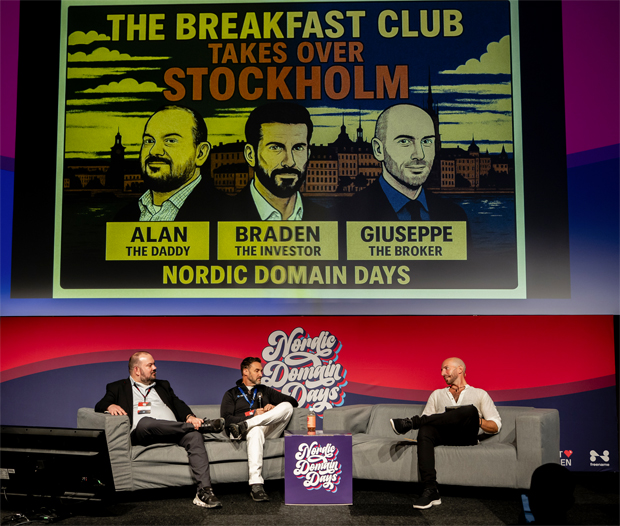
(Left
to right): Alan Shiflett (GoDaddy), Braden
Pollock (Legal Brand Marketing) and Giuseppe
Graziano (GGRG.com) during a live edition of The
Breakfast Club at NDD last year.
The
Breakfast Club podcast will return to the
stage next week, followed by a panel on what decades
in the domain business teach you, featuring Monte
Cahn from RightOfTheDot, Kimberly Darwin,
Yiqiu Tao from Dynadot, and Dave Evanson
from Sedo. The third panel tackles domain
monetization with Rickard Vikstrom from
DomainCrawler, Paul Dinin from Giant Panda,
James Tuplin from Above.com
and Claus Barche from Taku by GMO.
On
the policy and abuse side, Keith Drazek from
Verisign and Bertrand de la Chapelle from the
Internet and Jurisdiction Policy Network open
Tuesday with an update on the Internet
Infrastructure Forum. Thomas Rickert from eco
covers NIS2, ICANN's DNS Abuse Mitigation PDP, and
what comes next. Rowena Schoo from NetBeacon
Institute, Prudence Malinki from MarkMonitor,
and Henry Chan from the Trusted Notifier
Network add depth to what is probably the strongest
policy lineup we have had.
The Tech!
segment on Tuesday afternoon, hosted by Ulrich
Wisser from ICANN, has seven sessions running
from DNSSEC automation to Anycast DNS operations to
dangling DNS threats. And our two Master Classes
cover crypto agility (DigiCert and Excedo Networks)
and AI tools for domain investors (Alan Shiflett,
GoDaddy).
The
common thread is practical, honest content. We do
not do sales pitches on stage. Every speaker is
there to share something the audience can take home
and use.
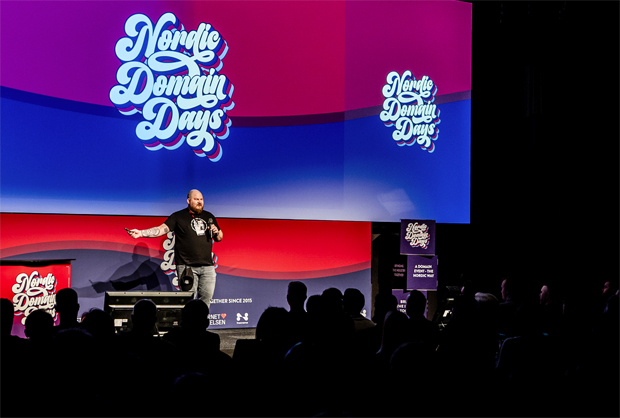
LG
Forsberg welcoming at full house at NDD 2025 last
year in Stockholm.
DNJournal:
Alongside the extraordinary line up of speakers and
sessions, Stockholm itself is a big reason
people that NDD has flourished. What kind of
networking and local flavor experiences will
be part of NDD 2026?
LG Forsberg: Stockholm
in late May is hard to beat. The sun barely sets,
temperatures are above 20 degrees Celsius, and the
city comes alive. The venue, Clarion Hotel
Stockholm, is in Sodermalm, the part of the city
with the best restaurants, bars, and atmosphere.
The
social program is where NDD really separates itself.
Sunday evening starts with Welcome Drinks in the
Living Room Bar, followed by the VIP Dinner (a
three-course seated affair), and then .blog Sunday
Night Live with karaoke on the main stage. Monday
after the program wraps, we have After Work drinks,
the traditional Meatball Dinner (yes, Swedish
meatballs every year, and you always eat too many!),
and then the Grand Social Event with live music acts
performing on the main stage. I will keep the lineup
as a surprise, but if people were at NDD 2025 with Dr.
Alban and Gunther, they know we do not
do things halfway. Tuesday closes with a
Farewell Dinner, this year a Swedish Taco Buffe.
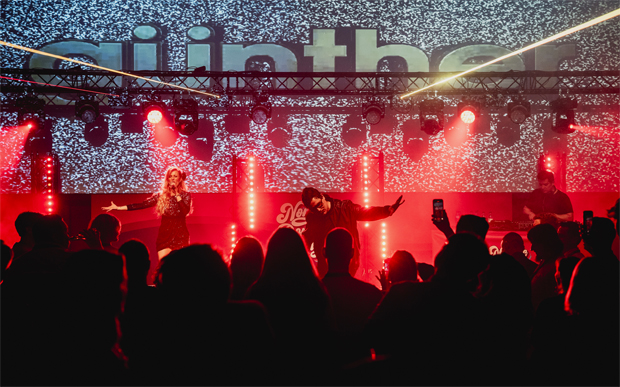
Live
music will be a big part of NDD's social program
again this year.
Throughout
the event, there is the NameSRS Arcade Lounge,
the NDD Pinball Corner, the VIP Lounge
hosted by Hello Registry, our meeting spaces,
and of course, something we do not advertise ahead
of time but has become one of the most talked-about
traditions at NDD. I will leave it at that.
The
real magic is the format itself. By keeping
everyone under one roof, at one hotel, eating
together, socializing together, and staying
together, the connections happen naturally. There is
no running between halls, no competing side events,
no splitting the group. That is by design and it is
the single most important thing we do.
DNJournal: While
domains are a global platform, every region has
their unique characteristics. What is the current
domain business environment like in the Nordic
countries (and for their respective ccTLDs)?
LG
Forsberg: The Nordics are in an
interesting position. The ccTLDs common here (.se,
.dk, .fi, .no, .is, and .nu) are mature,
well-run, and trusted. They are not the
fastest-growing TLDs in the world, but they are
among the most stable. Internetstiftelsen,
which operates .se and .nu, continues to invest
heavily in DNS infrastructure, security, and
research. They are one of our partners this year,
and Kristian Ormen from their team opens the
program on Monday with a session on thick versus
thin registries, which ties directly into a major
structural change they are implementing for .se.
What
is distinctive about the Nordic domain market is the
trust factor. Consumers and businesses in
Sweden, Denmark, Norway, and Finland have high trust
in their local ccTLDs. A .se domain carries weight
in a way that is hard to replicate with a generic
extension. At the same time, the registrar landscape
is competitive and innovative. Companies like Loopia,
Oderland, and NameISP are pushing
modern, user-friendly approaches to domain
management.
The
broader trend we see is that the Nordic domain
community punches well above its weight
internationally. Netnod runs some of the
most critical DNS infrastructure in the world from
Stockholm. The DNS Abuse conversation that is
shaping global policy has strong Nordic voices. And
the investment and aftermarket side, while smaller
than the US market, is sophisticated and growing.
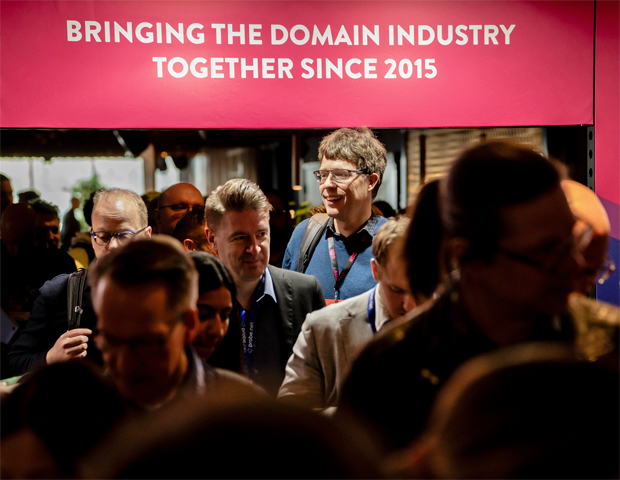
NDD
itself reflects this. We started as a Nordic
event, but today over 75% of our attendees come
from outside the Nordic countries. The Nordics
gave us the foundation, the values, and the
meatballs. The world showed up for the rest!
|