|
"Without
much of a social life after we moved to Canada in
2000, I had a lot of free time to spend time
online," Yoni recalled. "I did a lot of
online reading, exploring and playing video games. At
some point I read that people were selling products
online. Ecommerce was the wild west and consumers
were too afraid to input their credit card online. So,
often sales followed the dial-in phone sales model
that was optimized by infomercials. Individuals were
willing to pay for someone to create a web page and
logo in order to send leads to their physical
business. I tried everything. At some point affiliate
marketing caught my attention. The game became
acquiring traffic for X and selling for >X. I
remember making $50 a month right before
starting high school and thinking how amazing it is to
do so completely online. And while I was putting in a
lot of work to set everything up, once it was done,
the cash flow itself was recurring, while I was
sleeping!"
|
At some point I
ran into domain names simply because,
especially back then, domains had a lot of
type-in traffic. This completely changed my
perspective as now you could create a
tie-in between capital and cash flow and hence
you could scale the business by buying domain
names related to the revenue source. For
example, there were a lot of affiliate
programs for downloading music as this was
conceptually new. Consequently, I started
buying a lot of mp3 domains with a plan
of capturing valuable leads towards conversion
in the sales funnel. Remote work didn’t
exist back then and for me personally, 90% of
it was the proof of the possibility of that
concept. Beyond that, it was just a question
of increasing the revenue number. |

|
"In 2002
I began experimenting with domain names,"
Yoni said. "When I
started studying business in university, in 2004, domains
became my focus, and I started making $5,000 to
$10,000 a month. As I delved more into operating a
business, I realized that the professors who teach
aren’t good enough in the subject matter to be
operating one on their own! At that point, I was just
optimizing for a faster pathway to graduate as
I could tell that my degree was going to be of no use.
In 2005, I started heavily focusing on the business
and began traveling to TRAFFIC conferences and making
more deals. Revenue had increased 10x and in
2006, 20x more.
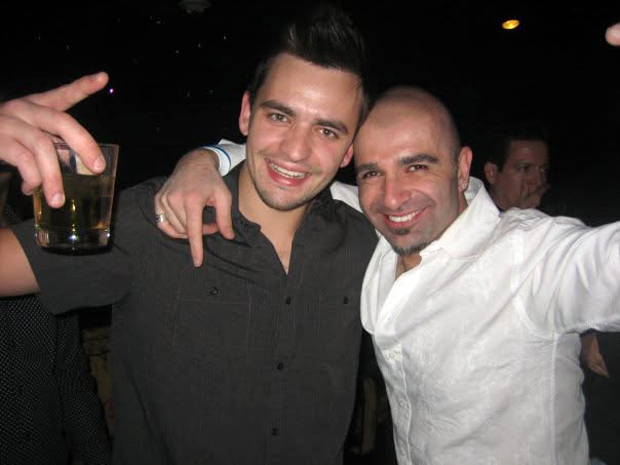
Yoni
Belousov (left) and Ammar Kubba at the 2010
TRAFFIC conference in Las Vegas.
When domain conferences arrived (starting with the
2004 TRAFFIC conference in Florida), investors and
developers were able to meet face to face for the
first time, resulting in friendships and often
partnerships that have continued to strengthen with
each passing year.
While
Yoni enjoyed success with domains from the start, he has
never taken good times for granted. We've all seen
this
business go through ups and downs due to changes both
within in the industry and in the pverall business
climate. We asked Yoni what has helped him successfully
navigate those changes and continue to grow. "Throughout
my domaining experience I have had to make countless
changes to adjust to the feedback loop of trial
and error," Yoni said. "However, there were a couple of times where
I had to pivot dramatically. Originally, I started this business via
affiliate marketing but when Google Adsense appeared
domain parking became 95% of my revenue.
However, ever since 2007, the domain parking business
has been on the decline on an RPM basis, and this has
held true for the past two decades. Before the decline
started, it became apparent that it was too risky
to depend on domain parking alone."
"I decided to
pivot more into domain sales. Even though it
was still domain names, this meant a completely
different methodology, a different cash flow and business model. But to even get there, the hardest
part is acquiring the inventory. In fact, this
meant trial and error for everything from scratch,
even in terms of the philosophy of what is a
“premium” domain name, why it is valuable and more
precisely, how valuable?"
"I started by acquiring commodity
domain names. It’s hard to compare
onlineautoinsurance.com with redfish.com with
chair.org and even harder to assign end user value and
thus liquid wholesale value to them. However,
commodity names such as 3-letter .coms and
others that had measurable standardized quality were
much more comparable and hence easier to do deals
on. This is what I concentrated on acquiring by
reinvesting my cash flow from domain parking. In terms
of trial and error they were also more forgiving
because if you overpaid, you won’t lose as much if
you liquidate. My bigger break came through
an unexpected TLD: .cc."
|
"One
day in 2006 I saw a user list a portfolio of 150
2-letter .cc domains for sale and
they were selling one by one for an average of
$1,000 each. I wanted to buy cc.cc and
a couple other ones but I was confused about
how it was possible that one person had 150 of
the best 2-letter .cc names. I was worried
they may be stolen so I started questioning the
seller and he informed me that everything is
legitimate because he bought them directly
from Verisign, who administered the |

|
|
.cc
registry, and until that point they had withheld
them from general availability. Even more oddly,
he managed to do the deal by contacting their WHOIS
email address! I decided to test out this
story and reached out to the same address.
To my surprise, Scott
Higgason at Verisign (now a VP at
Trillion.com) replied confirming
their willingness to sell them for $100 each.
This was exceptionally interesting because they
were all renewed for almost a decade ahead
which meant that the asking price was less than
the aggregated prepaid renewal fees." |
"So,
I bought cc.cc and attempted to do a deal with
Verisign for the rest of their two-letter
names, which was approximately 500 of them. In
the meantime, a different individual independently
came to the same conclusion I did, bought the next
best 100, and started selling them individually as
well. I realized that I must do three parallel deals
between Verisign and the two domainers as this was the
only way for me to secure the full inventory and
dictate the end-user sales pricing & strategy.
I did a bulk deal with each of the three parties and
ended up with almost 650 of them, which was over
95% of all possible combinations, and I started
selling them one by one at an average of $5,000
each. People were mainly buying them in the form of
novelty for a shortener or an email domain."
|
"Sales were
trickling in slowly and I didn’t mind as the
renewal costs were covered. However, around
2010, I started getting inquiries in
Chinese that were simply leading nowhere
due to the lack of English and lack of payment
methods for those Chinese buyers. Then one day
I had an inquiry for wz.cc. The buyer
said he is a poor college student from China
and cannot afford to pay anything for the
domain name and that if I gave him the domain
for free, he could help me sell .cc names
to the Chinese market. I made a deal with
him - if he can sell three domains for me, he
can have wz.cc for free. He sold three in his first
week! From then on, this became a
partnership which allowed me to enter a
very unique market: selling domains with
Chinese appeal, owned by Western domainers, directly
to China." |
|
"Acquiring
good inventory was even more capital intensive than
acquiring traffic domains, so initially most of my
efforts concentrated on pure sales velocity,"
Yoni said. "We would be buying a domain name such
as baobei.com for $75,000 because we knew we
could flip it for $95,000 the next day and we kept
repeating the process, very often in bulk. In the
domain world everyone wants to make 100x what
they’ve paid. However, if you’re able to flip a
domain name each day for 5% more than what you paid
for, you’re out-competing someone who made a
100x in a year by 6 orders of magnitude. IMO the main
thing which makes someone a good steward of a domain
portfolio is capital efficiency. Very quickly
we were the #1 seller to China - for all their
favorite possible types of domains: 3N.com,
3N.net, 4N.com, 4N.net, 5N.com, 5N.net, 3L.com,
4L.com, pinyin.com and all short domains. Soon
afterwards we topped $100 million in sales to
the Chinese market. During this process, I became
better capitalized and the model changed more towards
a buy and hold strategy. However, buy and hold
meant a further pivot to less liquid names with a
wider delta between end-user prices and wholesale
prices."
"By
2012 the pivot has completed successfully and more
than 50% of my revenue came from domain sales
rather than traffic monetization. By 2017, 95%
of my revenue was from domain name sales with a peak
of over 100,000 domain names under management.
As you master the craft, the trial and error turns out
to be more tame and less dramatic," Yoni
observed. "The ultimate macro trial and error is
the restart of the process due to an eventual pivot.
While this is the most difficult part, it is also the
most necessary."
|
In 2021 Yoni took
a major step beyond buying and selling
to
running his own registry by buying the .link
TLD in an auction. Yoni explained how this
shift came about. "I had planned to apply
in ICANN’s 2026 round of new TLDs for the
past decade, however, suddenly, an early
opportunity came around in the form of Uniregistry
Founder Frank Schilling’s TLD auction.
We decided to go after .link as we believed it
to be, by far, the most valuable one in the
collection. I wasn’t expecting us to win it,
but we did."
"This reluctantly
introduced a new heavy pivot to the
business, as we now had to go through the
trial and error of running and growing a
registry. But before that, the harder
pivot for me personally was to delegate.
Fortunately, we have found an amazing GM for
the registry (named Nova) in Vaughn
Liley. Today Vaughn is also the CEO of the
overall Link Freedom Group (LFG) and
without him, this simply wouldn’t have been
possible."
|

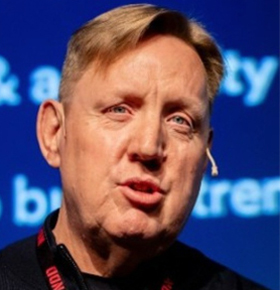
Link
Freedom Group CEO Vaughn Liley |
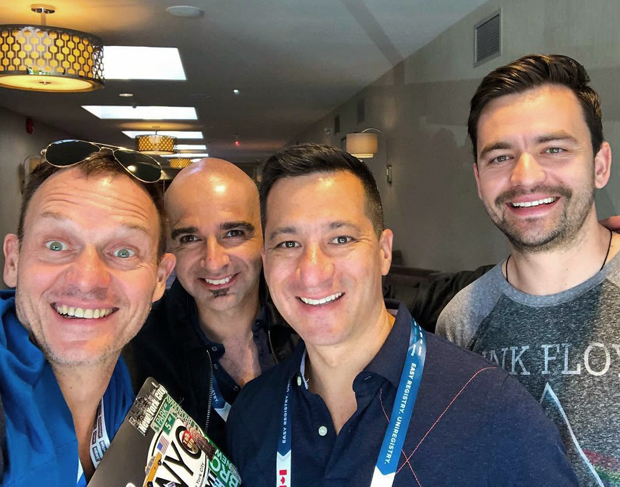
(L
to R): Industry pioneers Frank Schilling, Ammar Kubba,
Richard Lau & Yoni Belousov.
Yoni acquired the .link TLD after it was auctioned off
by its previous owner, Frank.
Getting
.link was just the start of Yoni's registry
operation ambitions. "Ever since the last round
of new TLDs ended in 2012, I was determined to
apply for some TLDs this round (2026)," Yoni
noted. "I had a passive list of TLDs collecting
and updating in the background as trends were shifting
based on multiple variables such as call-to-action,
length, registration data, search data, or simply
because they were funny. At the end we had a list of
approximately 2,000 strings that were eliminated to
become the smaller list of 300+ that we applied for.
The ones that made it through are a diversified
position of tens of variables, often aggregating a
variety of them in a single TLD. This was done
to ensure flexibility of the business by not
relying on an individual business plan."
|
"Towards
the last 18 months, this started being the
focus of our attention. Based on
ICANN’s policy of primary and secondary
strings, we started optimizing the whole
process to have two synergic strings for each
application. There were a lot of risks at
play, but the biggest known unknown was the
total number of applications. The range was
quite uncertain: it could have been 1,000
applications or 10,000 with most guesses
hovering around 2k-3k. In hindsight,
given the number of applications that ICANN
has revealed (1600+), I would have applied for
at least 100 more TLDs," Yoni
declared. "From a business perspective, I was
interested in investing in new gTLDs to be
able to scale beyond our capacity with
individual domains and domainportfolios.
This also acts as a diversification
strategy and an interesting |

|
|
moat
for the post AI world. In general, the
TLD business better aligns with my position
that digital sovereignty can only be achieved
by owning your own domain name,
regardless of the quality metrics," Yoni
said. |
Even
with LFG's huge new TLD project on their plate, Yoni
and his partners still keep an eye out for new
opportunities. "We still actively buy domains,
even on an individual basis. However, we mainly buy portfolios,"
Yoni said. " Sometimes we will acquire individual
names, but they must be exceptional. Examples include:
Andromeda.com, Router.com, Kitty.com, Hamster.com,
Farmer.com, Badminton.com, Krypton.com, Kale.com,
Certificate.com, Compound.com, Distribution.com, etc.
While we are still very bullish on premium domains
as an investment, given the small size of our team, we
are preoccupied with the diversification of our macro
portfolio. Given that 20% of our acquisition efforts
result in 80% of our inventory in absolute quality
terms, the logic was to eliminate 80% of the effort
that results in the final 20%."
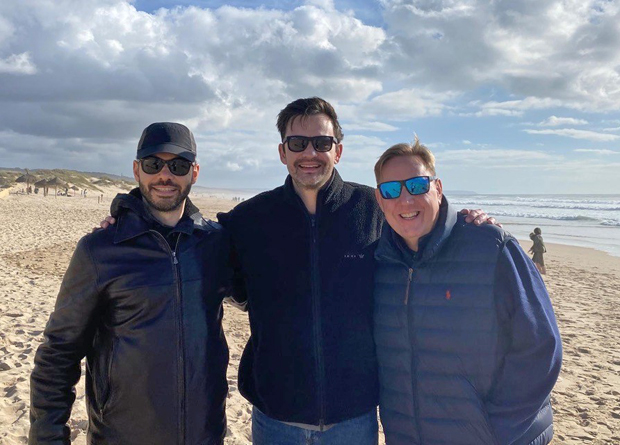
Above:
Link Freedom Group Minority Investor Nik, Founder Yoni
Belousov & CEO Vaughn Liley. Below: LFG Minority
Investor Jeff Gabriel & Advisor/Portfolio Manager
Dan Adamson
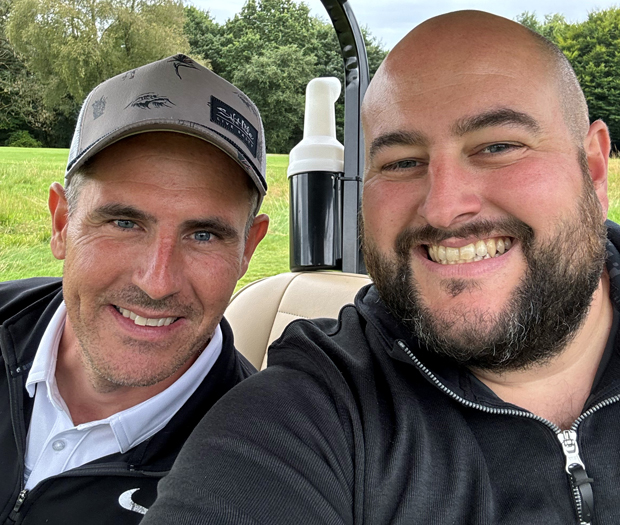
When
people get as busy as Yoni has been I always wonder
how much time they have left for other things in their
life. On that topic Yoni told us, "These days I
prefer to minimize my screen time. To some
extent it is back to basics for me to the same
things I liked as a teenager. I do have additional
interests with future tech such as photonic
computers, space mining & super
intelligence. However, most of my time I choose to
spend time with my family doing real life in our small
surf town in Portugal."

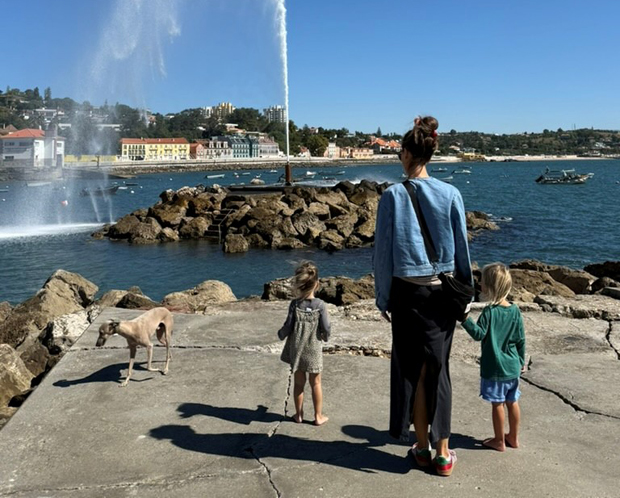
Above
& below: Yoni Belousov, his wife and their
3-year old twins enjoying life in Portugal.
In
reflecting on his journey and what he loves so much
about his occupation, Yoni told is, "I think the
best part about it is the pure flexibility. It
can require as much attention as you decide to
dedicate to it. You can work from home. It is completely
global, so you don’t rely on an individual local
market. You can move between countries, yet the
domains remain in your account. You have flexibility
of the strategy, the types of names, the TLD and exact
method of acquiring inventory and similarly flexible
on the sale. This is technically a cash flow business
that is capital intensive, but at the same time your
capital is stored in one of the best forms of assets
there are. This is effectively a real estate play
without the local risk and the friction of physical
assets and yet it derives a lot of its value from the
index of worldwide tech."
There are some teenagers around the world reading this
story right now. With his business journey having
started while he was still in high school, we wondered
what advice Yoni would have for them. "I am
naturally introverted, but I learned to be more
extroverted by simply doing it anyway," he
said. "There are no magic bullets. The answer is following
through and learning with each iteration. If it is
difficult, it’s a sign you’re gaining insight. The
internet has created an immense window of opportunity
and today that is simply truer than ever.
Everyone, regardless of age, location, budget or
education has the same potential. However, the
internet has a way of funneling users towards
consumption rather than productivity, so the first
challenge is simply to get going!"
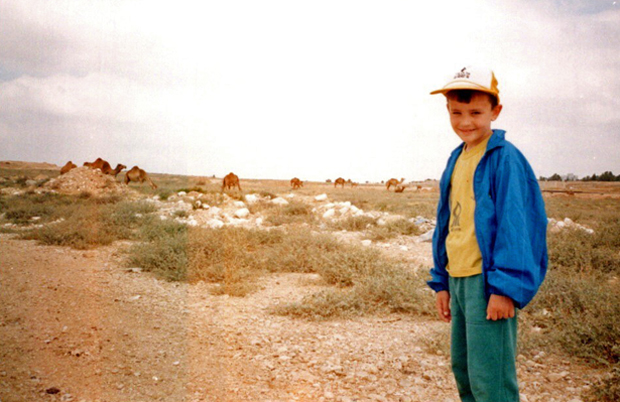
Having
already been down a rocky road in his youth, Yoni has
sound
advice for young people who may want to follow in
his footsteps.
"Once
you start, the most important part is to be open to
opportunities, find something you enjoy that
also has commercial viability (in the medium/long
term) and then dedicate effort & time to reiterate
it via feedback loops. There are a lot of risks
– you could be doing it all for nothing or even
negative monetary results in the event of a failure.
But that’s also why the reward is high
– because this risk is priced in."
|