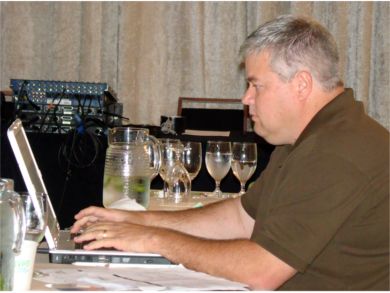
Howe
About That! The Inside Story of One Man's Rise From Low Budget
Domain Flipper to Million Dollar Dealmaker
I've
known Page Howe ever since he showed up on DNForum.com
in early 2003 looking to rebound from a .com bust that
had decimated his extensive Internet business ventures. Howe was
there hoping to climb his way back up the ladder by buying
domains, often for under $100,and flipping them
for $1,000 or more.
Flash
forward four years to 2007 and there was Howe standing on
top of the world after completing not just one but two
seven-figure sales in the same year, Seniors.com for $1.8
million and Guy.com for $1 million.
Move
ahead to June 2008 and there was Howe again at the GeoDomain
Expo live auction in Chicago, spending six
figures to snap up domains left and right for his rapidly
growing geodomain empire. In four short years Howe has become
the poster boy for the amazing things that are
possible in this business.
For
those who wonder if it is still possible to make it big with
domains, Howe replies
Page
Howe Site HQ Inc.
with an emphatic Yes! In fact, he says the basics
really haven't changed much at all. "In many ways, this
feels like 2003 all over again," Howe said. "The same
types of things I was doing then I'm still doing now with the
same rewards - so I guess I should keep doing it!"
Just
as he did four years ago, Howe puts in long hours researching
purchases that he believes have a good chance of producing
profits down the line through resale, domain monetization or development.
The only difference now is that after years of continually
reinvesting his profits and "trading up" he is in a
position to buy and sell more valuable domains. This is the
previously untold story of how Howe discovered the domain
business and went on to become one of the industry's key
players.
This
converted church is home for
Site HQ's Manchester, Tennessee offices
Howe
currently lives in Manchester, Tennessee, a town of
just over 8,000 people located along Interstate 24,
halfway between Nashville and Chattanooga.
The population of Manchester swells to more than 100,000
people in June when music lovers from around the world
converge there for the annual Bonnaroo
Music Festival, but the rest of the year
Manchester offers plenty of peace and quiet. In fact the
office for Howe's company, Site HQ Inc., couldn't
be more peaceful - it is located in a 100-year-old
converted church building that he bought for just $90,000
(proving he can spot bargains offline as well as on).
The
reason Howe, a native
Californian, wound up in south
central Tennessee, is a a key part of the boom, bust and
rebirth story that led him to domains, so we will come
back to that a bit later - but first things first.
Howe's
story begins with his birth in Burbank, California in
1963. Burbank is home to many movie and TV studios (including NBC-TV)
and Page's dad had moved there from Memphis to take a
managerial position with a major industry trade group, the National
Association of Broadcasters. His mom and dad named him Hampton
Page Howe in honor of his great grandfather Harry Hampton
(a native of Scotland) who in the 1920s was one of
the original members of the PGA (Professional Golfer's
Association) tour.
After
graduating from high school in Burbank, Howe headed for the University
of Redlands, a private liberal arts college about 60 miles
east of Burbank. He didn't know it at the time, but the
curriculum there, focused on teaching students at least a little
bit about a wide variety of subjects, would wind up being a huge
asset when he entered the domain business years later.
"What a perfect application of the liberal arts education -
to be grounded in so many different areas so you can identify
names with potential value," Howe said. He also gained some
practical work experience during his college years as he had to
work to pay his way through school.
Howe
got to know many members of the university's
administration and faculty while serving in student
government. In a perfect example of what a small world we
live in, more than 20 years after he graduated from
Redlands, Howe would bump into school trustee Larry
Burgess at a domain event, the Sedo
Pro Forum, at the Mohonk Mountain Resort
in New York State's Hudson Valley in June
2007.
The
historic Mohonk resort was built (and is still operated
by) the Smiley family who happened to be major
benefactors of the University of Redlands where Howe had
spent many hours studying in the school's Smiley library.
Burgess had become something of a Smiley family historian
and happened to be at Mohonk the same weekend Howe was
there. The two were stunned
Domainers
cross a bridge at the Mohonk Mountain
Resort during the Sedo Pro Forum in June 2007
and delighted to bump into each
other after more than two decades and Burgess was
completely fascinated with Howe's domain endeavors,
agreeing with Page that it was indeed a unique and ideal
application of his liberal arts training.
Of
course during Howe's college years in the early 80s, there was
no such thing as a domain business, but he did feel that his
career would lie somewhere in the business world. The school did
not have a specific business program, so he fashioned his own by
focusing heavily on economics, political science, sociology and
cultural anthropology. In 1985 he graduated with a management
degree and was named the top student in his field of study as
well the Outstanding Senior at Redlands that year.
Howe
had particularly excelled in a class on taxes, so much so that
his professor hired him to work for him doing tax returns for
his last two summers in Redlands. "I really enjoyed
the challenge of it and the advising part of it," Howe
recalled. Upon graduation that interest led him to take a job
with a new company that was one of the first in a field that
became known as financial planning. "They were just
starting to use computers to plan out what saving certain
amounts of money would mean for someone who wanted to create
wealth down the road," Howe said.
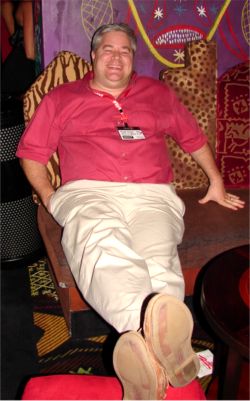
Howe
at a T.R.A.F.F.I.C. Orlando networking session May 2008
"The
company I joined, Perkins & Zures, had an exclusive
roster of medical doctors among their clients and I become
the contact person between the doctor's accountants and
our financial planning product. This was right in the
middle of a huge upheaval created by the Tax Reform Act
of 1986 that changed the rules regarding tax rates and
shelters. So I went from advising to actually structuring
some of these tax shelter products," Howe recalled.
"We
started getting some of our doctors together to actually
buy companies, not just for the tax benefits, but also to
profit from the growth of the companies. One of the major
places we invested was in cable television and
it
quickly dawned on us that much
more could be delivered on this wire into people's homes
than just the dozen TV channels they were used to
getting," Howe said.
"What
would happen if you could deliver 40 channels, or 100 channels
or direct movies and advertisements? I'll never forget giving a
presentation to these doctors telling them that by owning these
cable systems around the country you are going to own this wire
into people's homes and you are going to make money on
everything that comes in over this wire. Of course back then,
who could have known that this would include the amazing power
of the Internet as well."
The
cable TV investments paid off very well because they were made
just as the cable industry was being rolled up be a handful of
major players who were buying every system they could get their
hands on. That lesson is one that Howe is drawing on today as he
has switched his primary focus to geodomains, expecting a
similar roll up to take place in that industry. "I see
geodomains as sort of a non exclusive franchise to operate a
website for a specific community. I think some companies will
become very good at doing that and they will want to scale their
model by acquiring additional city domains," Howe
said.
After
six years with Perkins & Zures, Howe left to take a
position with the one of the company's clients, an MD in San
Diego who hired Howe to be an exclusive "family
office manager". Howe's job was to help them evaluate
and take advantage of investment opportunities. When the
web began to bloom in the late 90s Howe said "We
decided to put some money into a partnership to buy into
Internet companies. We analyzed around a thousand
different stocks and wound up putting money into both
private and public companies."
"That
was a terrific place to invest in 1999 and 2000 but it
became a terrible thing to be doing in 2001 and
2002," Howe said. When everything went south, Howe
saw many of the group's investments completely evaporate.
As the economic climate was starting to go bad Howe
thought he still had an ace in the hole. He had become the
chairman of a small public company and had a signed letter
of intent to sell the company for several million dollars
in 2000. Counting on profits from that venture, he decided
to turn a hobby he had a passion for - baseball cards -
into a full time job by buying a couple of card shops in
San Diego.
Howe
speaking at T.R.A.F.F.I.C. Orlando May 2008
As
they say, when it rains it pours. Not long after he took over
the stores the sale of the public company fell apart and the
company itself went down in flames with the many others that
were claimed in that tech bust. Howe wound up having to hunker
down and find a way to ride out the storm. He put his inventory
of some 200,000 baseball cards up for sale on the web and that
income plus some money from a part time CFO job provided the
only revenue streams he had left.
During
the good times he and his wife Penny had bought a second
home in her hometown, Manchester, Tennessee. To save money they
moved there in 2002. "We lived in North San Diego which was
very expensive, but we loved it there, so it was a very hard
decision to move back to Tennessee," Howe said. However
with Internet stocks imploding and many of his group's
investments plunging to zero it was the only option he had.
"I wanted to be able to
stay in business and try to recoup the investments that a
lot of people had made with me," Howe said. Before
everything had gone south his investment group had started
dabbling in domains. "We had originally stumbled into
the business after reading a story about Chris Ambler
trying to get ICANN to approve a new .web
extension," Howe recalled.
The
story behind the hat: At the T.R.A.F.F.I.C. West
conference in Las Vegas in February 2008 Australia's
Michael Gilmour donated this hat from his homeland to
be auctioned off to raise funds for the domain industry's
non-profit trade group, the Internet
Commerce Association. Howe won that
auction and the hat with a generous bid of $5,000.
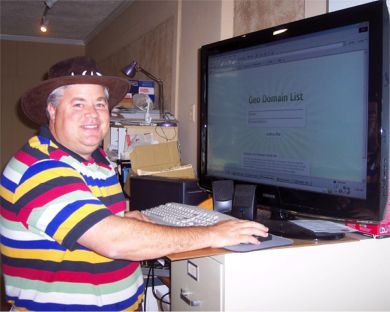
In the photo above, Howe sports his new headgear at his
Manchester, Tennessee office.
"There
was a perception at the time that all of the good domains
were taken in .com, so we thought something like .web
might be a new opportunity. But we discovered most of the
good names in that extension (which still has not been
approved) were already reserved by one guy! So we thought
the ideal thing to do would be to own an extension of our
own so we could control all of the good domains."
"That
got us involved in ICANN's new TLD process and when they
started taking applications we applied for .kids
and at the same started up a registry company called Basic
Fusion that we planned to use to operate the
registry." While the ICANN process moved along at a
snail's pace, Howe's group decided to get some real world
experience in running an extension by joining with New.net
to operate their .kids extension.
New.net
tried to market dozens of extensions that were not approved by
ICANN and that could only be seen if people had a browser plug
in that made them visible, or used an ISP that contracted with
New.net to make the extensions usable. That lack of universal
coverage doomed New.net's efforts. The ICANN application for
.kids was never approved either so Howe was hitting brick walls
everywhere he turned.
He
also lost the $50,000 fee ICANN charged those who applied
for new TLDs (something potential applicants should keep in mind
before getting involved in ICANN's plan to offer an unlimited
number of new TLDs starting in 2009. There is no guarantee you
will ever get approved). After his experience with .kids Howe
said he would never again get involved in any business
proposition that depended on ICANN approval.
While
the .kids effort was fizzling the partnership busied
themselves by assembling a portfolio of about 4,000
domains, but by 2002 they wound up selling off or dropping
all but about 20 of those. One of the domains they let go
for around $8,000 was GasPrices.com, a
decision that came back to haunt Howe when he saw the name
fetch $225,000 in Moniker's live auction at the
T.R.A.F.F.I.C. show in Orlando last May.
Fortunately one his group kept was Seniors.com, a name
that would play a key role in turning Howe's luck back
around in 2007.
After
two years of one disappointment after another, Howe
stumbled across the busy domain name chat board at DNForum.com
in March 2003. "I found these people selling domain
names that I thought would have future value. So I felt
that as long as I was in for a dime, waiting for things to
come back with Seniors.com and a handful of others, I
might as well be in for a dollar," Howe said. "I
got out the credit cards I had that still had a little
room on them and started buying names from people on
DNForum."
Discovering
DNForum.com helped Howe get back on track
Having
once again been bitten by the domain bug, Howe also began using
the drop services to get additional domains, with the now
defunct NameWinner.com service his favorite because names
that weren't widely desired could be acquired through them for
as little as $9, a fraction of the minimum charged by SnapNames
who was the market leader at that time.
"That
started what has now been a five-year routine of studying the
delete list every day, deciding which ones were worth at least
$60 to me and entering those with the drop services. For others
I would wait and hope to pick them up for a registration fee if
everyone else passed on them," Howe said. Howe noted that
his portfolio is about 85% .com. "I had some
dalliances with other extensions and got some one-word domains
in .us and .info but have sold most of those
off," he said.
As
the domain industry started emerging form its long slump, Howe
was able to sell some names from his newly expanded inventory
for anywhere from 30 to 100 times what he had paid for them. He
reinvested the proceeds in more domains and to keep his
acquisition costs low, a key part of his strategy was to nibble
around the edges rather than compete for the most desirable
domains.
"There
were maybe 15 good domains each day and I knew that ten of them
were names that everybody knew about," Howe said.
"So I would try to get the other five that I had identified
through hard work. My edge was being a professional, doing it
full time, searching every day and not just relying on a
computer to filter names but literally looking at the lists
myself. I was trying to get strong names at the lowest price I
could, knowing that I couldn't get the best names because I
wasn't funded well enough."
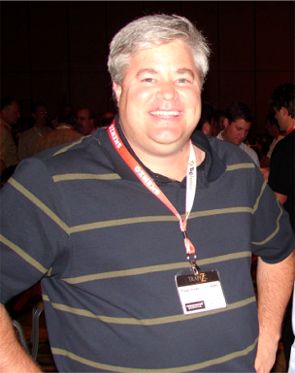
Good
reason to smile: Howe at
T.R.A.F.F.I.C. New York 2007 right after his domain Seniors.com sold for $1.8 million
Howe
said a big change that allowed him to get back in the game
was the decision by many registrars to start keeping their
expiring names to auction off themselves, rather than
letting them go into the general drop pool. That meant
buyers had to search many different venues for expiring
domains rather than just go to a couple of drop catching
services. Since Howe's model was based on outworking
everyone else, he found domains others overlooked because
he was willing to do the tedious spadework necessary to
uncover the good buys that were now spread across many
different venues.
Howe's
long climb back culminated last year with two blockbuster
sales. The best asset his partnership had left was Seniors.com,
a portal domain they had purchased off Ebay for $100,000.
That was one of the last domain investments the
partnership made before going into the storm cellar and it
is a good thing that Howe held onto it so long after the
bust. When he put it in Moniker's live auction at
the June 2007 T.R.A.F.F.I.C.
New York conference it sold for a stunning
$1.8 million, enough to make his investors whole
again.
With
his share of the sale revenue Howe now had enough money to start
targeting bigger game and he soon bagged Guy.com through
Sedo for a low six-figure price. Howe loved the name and decided
he wouldn't let it go for anything less than $1 million.
To his surprise, just one month later, a buyer stepped forward,
again through Sedo, and met his asking price, giving him a
second 7-figure sale, barely four months after his first
one.
With
a real war chest to work with now, Howe set his sites on the geo
domain market. "Originally I just wanted to get one
good city name so I could join Associated
Cities (the trade group for developed .com city
domain owners that stages the annual GeoDomain Expo). I wanted
to be part of the club to take advantage of the networking and
their knowledge of development," Howe said.
After
a long search he finally acquired his first geo, Victorville.com,
for $26,500 from Rick
Latona's sales newsletter. Howe was familiar
with the Southern California town because it was located
within an hour of Redlands where he went to college. Once
he got started down the geo path his ambitions expanded
and he decided to pursue what he sees as a great opportunity
in that sector.
Last
May he got another solid California city, SimiValley.com,
from Latona for $90,000 and at the GeoDomain Expo
live auction is June he picked up
Howe
racking up domain purchases at the
2008 GeoDomain Expo live auction in Chicago.
SantaClara.com and a
group of related domains for $85,000. He has also
added many other small to medium size cities that give him
a network that currently covers about 1.5 million
people.
Page's
wife Penny serves as
Site HQ's Office Manager
Howe
said he has been acquiring domains in 2008 at a faster
pace than ever before because, with the downturn in the
general economy, he is seeing more affordable prices. He
is using this window to try to acquire names that were
previously out of reach. "We knew that one of the
hardest things to get when domains were at peak values
were city domains, so we have been going after those while
we have this opportunity to get them. For awhile a lot of
city owners were saying I'm never going to sell
this domain no matter what but there has been some
loosening up now. We felt that we needed to act because
there are only so many cities."
The
expansion of Howe's business was aided by his hiring of a
General Manager, Marshall Gilliam, last December.
Among other things, Gilliam is handling the company's new
city development projects. Howe and Gilliam go to the same
church, golf together and now chase domains together. Penny
Howe is the Office Manager and Page has a sister who
helps
write content. Those helping
hands are critical to keep Site HQ's growth on track and
allow Howe to handle all of the irons he has in the fire.
He hopes to eventually roll out a sales site
for small business end users at JoeDomains.com
(a project he calls Domains for the Average Joe). The site
would sell names at different price points, starting at $99
and escalating to high value premium names so the business
buyers would have a choice that would fit their budgets.
The site would also offer a lot of hand holding in name
selection, taking care of the hosting, etc. so that it
would be a one-stop shop for small businesses that are
confused by the intricacies involved in acquiring a domain
and getting a site online.
Howe is also writing a book called Domain Name
Investing: How to Make Money in Internet Real Estate
that he would like to have out by the end of the year but
the release date has been a constantly moving target.
"The book has been on hold because there has been
such a great
fertile environment to go do
everything I am telling people in the book to go do and I
said why don't I just go do that!" As of this
writing, that's exactly where Howe is - out there doing
it and after all he has been through he is loving
every minute of it.